Ellipses

Ellipses are probably among the top ten most common punctuation marks used in genre fiction. In many of the books that I’ve seen they indicate a trailing off, pause or falter in the character’s train of through or dialogue.

Example:          “I just thought … ”

“He said you might be amenable … ”

Easy enough. Just three little periods mushed together and voila. But no, it isn’t that simple. Depending on which site you hit up and the grammar guru they’ve consulted and footnoted, the rules seem to change. Sometimes there’s three and sometimes there’s four and sometimes there can never be four… Yada, yada, yada.

So to stop my head from exploding, I checked the first ten sites, compared their references and am now setting forth how I’ll use them in the future, not because I doubt the sources but because these make the most sense to me.

Since the ellipses replace a word or words it will be separated by a space on either side but not between the three periods

Example: “I wanted to be there but you know how it is. First, the kids, then the dishwasher acted up, and … .”

Since the ellipsis is also treated as a word, I find it suits my analytical brain to add a space before the final punctuation of the sentence.

This would hold true if you are using an ellipsis in more traditional writing such as in a quote to show an omission of word(s).

Quote: “We shall go on to the end, we shall fight in France, we shall fight on the seas and oceans, we shall fight with growing confidence and growing strength in the air, we shall defend our Island, whatever the cost may be, we shall fight on the beaches, we shall fight on the landing grounds and we shall fight in the fields and in the streets, we shall fight in the hills; we shall never surrender, … .”

Shortened quote: “We shall go on to the end, … we shall never surrender, … .”

Sir Winston Churchill, June 4, 1940

It is important to note that it is unethical to change the meaning of the quote by using ellipses and the period at the end of the sentence ends the sentence and shouldn’t be confused with a four period ellipsis.

Posted in craft, Writing | Leave a comment

Doubt is a Four Letter Word

I don’t know anyone who’s been writing who hasn’t had their moments of doubt. In my span of fourteen years , some writers have been so overwhelmed by doubts that they’ve stopped writing. While other writers have been newbies, a few have been successfully published authors that walked away.

So where do these doubts come from?

Mostly, they are a reflection of our internal fears, aided and abetted by a tight, subjective market and tough competition.

Enter the Rejection Letter.

If you’ve submitted, you’ve probably gotten one of these babies. You know the lines–Dear Author, Thank you for submitting your work. Unfortunately, I do not feel I’m an the right agent for this work… A few are kind enough to wish you the best and remind you that this is a subjective business and blah, blah, blah.

Frankly, most of us stop reading after the rejection part. And while we’re told this is a business, it’s hard not to take it personally when there are so many ‘yous’ embedded in the text, you’ve spent months polishing and putting your heart and soul into it and someone just called your baby ugly.

So get mad, cry into your soda, attach it to a voodoo doll and stab the effigy with pins or rant to your writing buddies. You’re entitled to your emotions. JUST DON’T VENT IN A PUBLIC FORUM!

But set the clock–you have ten minutes.

Time’s up! Now put the letter aside and pull yourself together. Done? Good. Congratulations! You’ve had the courage to put yourself and your writing out there.

Then come back in three days and reread the letter.

Is it a form letter with dear author and then somewhere apologize for  being a form letter? If so, then feed it to the shredder. That lovely buzzing noise is the sound of you taking back control of your writing career and is immensely satisfying to boot.

But it if isn’t a form letter, then what?

That depends on what it says. If it pinpoints a specific area–such as your heroine is unsympathetic, I couldn’t believe she trained frogs for the ballet, etc. then find a person who reads the genre, have them read your manuscript then ask them about the area in question.

Why a reader and not a writer?

As writers we get hung up on rules. Readers just want to be entertained. And while grammar and craft are important, agents and editors are looking for the story that triggers their spidey sense.

It’s a small but significant difference.

And if there are no hints?

Then shred it. It’s served its purpose.

And while you may have dreamed about working with said agent/editor, they weren’t the right person for you.

The market is tough and jam-packed, you need as many cheerleaders as you can get in your corner raving about your latest story.

And you will find them. Because writers are readers too and many of us write the stories we want to read. But in the meantime, celebrate what you’ve accomplished–a finished manuscript, a toe-dip in the professional waters, and a few good friends that have bought a ticket for the same ship of dreams you’re on.

And if that’s not enough, I have a really loud shredder you can borrow to drown out your doubts.


Posted in Business, Writing | Leave a comment

Book Signing

I am proud to be an ebook author. I like ebooks—they’re easy to store, move and read on my pda. That said I also like paper books—the feel and scent of paper in my hands. Having both options available is one of the reasons I submitted to my publishers. While the majority of people who purchase my books buy the electronic version, I have a few who only read the paper copies. And having paper copies is very nice for book signings.

Of course, I’ve seen electronic copies for sale at book signings—usually accompanied by a mini-disk and a lovely photo of the cover. It’s nice to pop the CD in your computer at work so the boss sees you busy at the computer without really knowing what you’re up toJ. And the price of a disk tends to be cheaper than the print copy, usually by half or more (at least for small presses).

And speaking of books signings, I’ll be signing my books at the Glendale Chocolate Affaire tonight from 5-10PM, Saturday from 10AM-2PM, and Sunday 12-5PM. So if you’re close by stop by and say hi and sample the chocolate-covered cheesecake for me.

Or better yet, I’ll get my own piece! Numnumnum….

Posted in Business, Writing | Leave a comment

I am so passed past

Learning proper English grammar makes my head hurt. It’s confusing and once you think you’ve learned the rules, some punctuation God gives a ‘get out of Hades card.” And ta da—now you have to remember the exceptions too. Knowing this hasn’t stopped me from trying to learn but I must do so in small doses.
Very small doses.
This week’s migraine was brought to you by Passed and Past.
I started out slowly. Both passed and past are relatives of pass. Got that. Then things popped up like transitive, intransitive and participle. I break into a sweat and my brain starts pounding at the back of my skull trying to escape.
High school English gave me PTSD.
Once my heart settled below 150 beats per minute, I fell back on my old coping mechanisms: To understand the message, I’d ignore some words. The gist of what I learned is this—passed is a verb and past is everything else (noun, preposition and adverb).
Passed should be used as the past tense of the verb pass (There is an exception created by the Navy, but I’m not going to repeat it here as it borders on cruel and unusual punishment).
Correct: I passed my exam with flying colors.
Incorrect: I past my exam with flying colors.
Correct: We passed her house on the way to school.
Incorrect: Dinner is served promptly at half passed one.
Correct: Dinner is served promptly at half past one.
Correct: In the past, people would have to pound clothes against rocks to get them clean.
Correct: He raced past the finish line.
Check that you are using passed as the verb by rewriting into present tense—I’m passing my exam with flying colors and I pass her house on the way to school.
To double check past rewrite by substituting beyond in its place—He raced beyond the finish line and Dinner is served halfway beyond one.
Now off to take a Tylenol.

Posted in craft, Writing | Tagged | Leave a comment

Recharging the creativity well

Between writing, I like to recharge my creativity by reading books and watching movies.  This past weekend, I read among other things Ghost Ocean. It wasn’t quite what I expected from the title. In fact, it had very little to do with ghosts unless you counted be haunted by your past. But I did enjoy it and no, I’m not writing a review of it but I will rate it on Goodreads. I also started two other books. Unfortunately, I couldn’t get into either of them and put them down.

As a result, most of my time was spent watching movies and other shows on Netflix.  I rarely watch TV any more although Hallmark had a movie out and I rarely miss a Hallmark movie. Some day someone is going to write a how-to-write emotionally packed books using the Hallmark method. But I digress…

Usually get far away from my writing genre as possible (to avoid influence on my writer’s voice), but this weekend I had no such stipulations and watched several stories with romantic elements including It’s Complicated, Shrek, the Final Chapter, and Sabah with Malice in Wonderland (2009) dancing on the fringes. Of course, I also watched the Gravedancers and a really bad SciFi movie that shall remain nameless. On the documentary front, I enjoyed Hiroshima, Yellowstone, the Appalachian Trail, an episode of The Universe, and Paranormal Kids.

The story fairy has filed some of the information in the documentaries for later  use.


Posted in Books, Movies, Writing | Leave a comment

Making Readers Believe in Angels and Aliens by Vijaya Schartz

Making the reader believe is the author’s job. It’’s an art, and it’’s a craft. Just because my Blue Angels are of an alien nature doesn’’t mean I can’’t make them real to the reader. All the information I use in my books is steeped in known cultural elements, like the Old Testament, ancient Sanskrit texts describing Blue Gods waging war overhead in flying chariots of fire. There is also the Native American legends of shape-shifters, skinwalkers, and entire populations abducted by Star People, due to return sometime in the future.

I raided a few of these themes for my novels, not only because they fascinate me, but because I believe they resonate among readers. The secret in making any story believable is to anchor it in gritty reality, or in familiar lore. Many believe in angels, either as spiritual guides or as religious symbols. Others believe we have been visited by aliens in the ancient or recent past – almost half of the US population, according to a recent survey – and the numbers are growing. So a story about aliens posturing as angels is not so farfetched… If you watch the History Channel or History International about Ancient Aliens or UFO research, you know exactly what I mean.

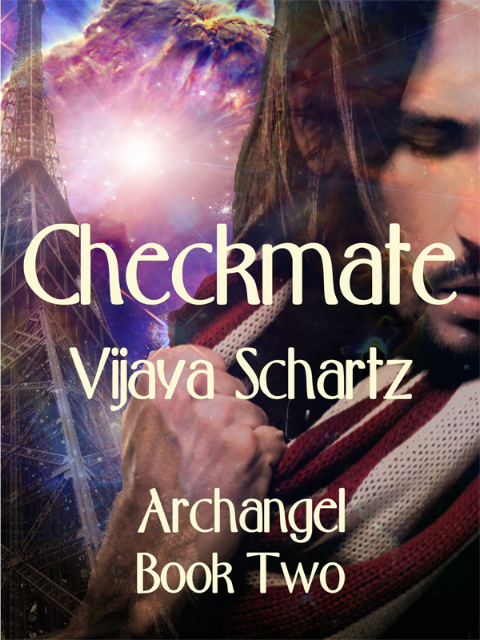
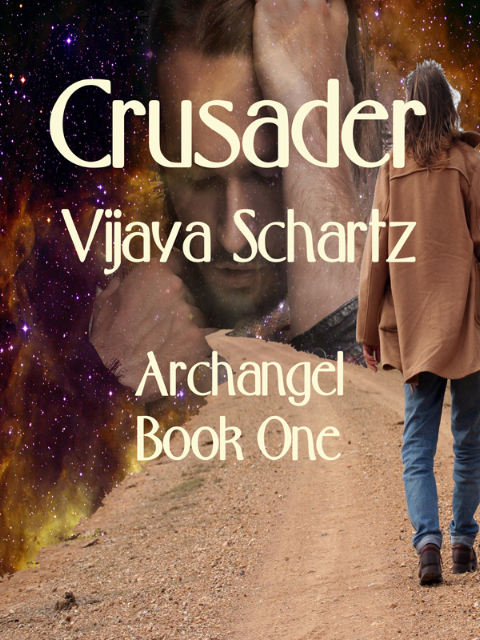
The hero of the Archangel twin books, CRUSADER and CHECKMATE, is named Michael, and not by accident. He never suspected he was a half-human reincarnation of the great Archangel warrior. He had a rough childhood on the Reservation and has fallen low among the human ranks. But he fathered a daughter, his pride and joy, and he has a classy girlfriend for whom he works very hard and tries to better himself. Still, his feelings of inadequacy drive him to drink more than he should. This is an anti-hero anyone can relate to. We all know this type of handsome, roguish alpha male.

When the call comes from above to fulfill his destiny, Michael first disbelieves. Drinking leads to hallucinations, right? Then as the reality of his birth starts to sinks in, he is neither enthused, nor ready for the hardships ahead. But destiny has a way of asserting itself. When evil strikes his girlfriend and targets his daughter, Michael, a fiercely loyal family man, has no other choice but heed the call.

But the arduous road to becoming the shining angel he aspires to be is full of pitfalls. Here again, the reader can relate to his flawed journey. Alcoholism is a difficult demon to overcome. But like all mythological heroes (yes I borrow ideas there, too), he gets help from a powerful source. Help yourself, and heaven will help you. That’s the familiar, accepted rule.

Whether they believe in angels, or aliens, or none of the above, readers can relate to the human drama and Michael’’s fight to save what is good and decent. Since I pride myself in making the unbelievable totally believable, the best compliment I received from readers of this twin series, besides “I couldn’’t tear myself from that book,” was “It could be happening right now, and we wouldn’t even know it.” Then I knew I had hit my mark.

For more, visit my extensive website at: http://www.vijayaschartz.com

You can also friend me on Facebook or My Space and various other networks.

CRUSADER – Archangel book One:

Michael Tanner, proud, brash, irreverent, half Native American, and single father, doesn’t believe in aliens. When a Blue Angel claims to have fathered him, Michael knows his drinking has gone haywire… But a seductive Prince of Darkness born of a nightmare now targets Michael’s family. When his girlfriend disappears and characters from his dreams suddenly materialize to threaten his daughter, Michael must come out of denial and overcome his weaknesses, to face the unbelievable mystery of his birth and fulfill his unique destiny.

“…engaging and fast-paced… a harmonious mix of enticing story… where real people do extraordinary things… humorous and hopeful… fluid and entertaining… quick and often droll dialogue… a marvelous tale of good and evil…” The Charlotte Austin Review

“…Lavishly described, expertly written with stirring descriptions that take one’s breath away. Author Schartz has written a solidly absorbing, old-fashioned science fiction novel of good and evil, yes and no, the one and the many.” – The Book Reader

“…relationships, angels, aliens and seduction… even Satanism… kept this reviewer riveted… compelling fantasy… you won’t want to put it down… superior… enthralls, and, at the same time, awakens!” – Metaphysical Reviews

“A mighty fine tale primed to read through in one sitting.” – Curled Up With a Good Book.

CHECKMATE – Archangel Book Two:

To quench his vengeful lust for the Archangel who scattered his remains at the edge of the universe, the Reptilian ruler orders the sacrificial death of Michael’s teenage daughter. Half human and a full-fledged Archangel on his father’s home world, Michael must return to Earth to save his daughter from fiendish claws, and his native planet from enslavement or worse… But the way home is fraught with dangers, some more insidious than others. Nothing prepared Michael for the kind of trial he must face, when his rambunctious past catches up with him at the worst possible time…

“Sword-and-shield adventure… aliens and angels and dreams truer than life and depraved shapeshifters and evil sorcerers and parallel universes… Funny and sad and very intelligent.” – The Book Reader

“Wickedly insightful. Grab this today along with the prequel, Crusader.” – Five stars – Curled up With a Good Book

“…charm that keeps you reading… A fun piece of escapism… hours of sheer entertainment.” – Rapport Magazine

“You will be hooked… a good read from start to finish.” – Alan Caruba – BookViews

“Rollicks right along at a good clip… a fun concoction and a fast, zippy read… Really, this one is among the most pleasurable.” – Writer’s Digest

These books are available at All Romance eBooks, Amazon Kindle, Smashwords, and soon at B&N Nook and Borders Kobo.

 

Posted in craft, Science, Writing | 1 Comment

The Birth of an Idea

After I finish a manuscript I like to take a few weeks to a month and read what I’ve missed. Unlike some writers, I haven’t quite mastered the art of reading fiction while I’m writing it. I find that too often my prose begins to sound like the author I’m reading. (Not exactly a good thing when it’s you voice that sets you apart from the crowd.)

Normally, spending the time reading doesn’t present a problem. I have a large to-be-read pile that never seems to diminish. And there is the matter of what to write.

Should I begin the next book in the series I’m currently querying agents about? But what if I need to make substantial changes in order to sell? What if I write something else and zoom-zoom I sell the book and they immdiately want the second book in the series. It would be a good and a bad place to be in. Good to sell, bad to have to abandon a story half-way through. (I have yet to train my brain to work on multiple stories at one time.)

But this time, I got a great idea for a story. A wonderfully twisted story and my brain is bobbing in whatever cerebral fluid remains inside my skull trying to get me to tell it.  Normally, I write it down in one of my many notebooks of story ideas (For me coming up with the idea is easy–finding the characters to people them is hard). This usually appeases the story fairy and I can go back to reading.

But this time was different. This time ways to tell the story kept cropping up in the back of my mind before popping up completely at random. So now while I struggle to read a book I picked up, I’m fending off this story idea. I keep telling myself that if it’s still there come February 1st I just might write the dang thing.


Posted in craft, Writing | Leave a comment

En and Em Dashes

One of the things on my list of things to do this year is to work on understanding the mysteries of English punctuation. While I understand the basics—like periods and exclamation points—the use of other more exotic punctuation remain a nebulous fog. Since I don’t feel quite up to wrestling with commas and hypens, I thought I’d start with the small stuff.

The En Dash

The only reason I know about this is because it seems linked to the Em Dash.  This dash is the size of the letter N, has no spaces before or after it, and stands for ‘through’ in a series of numbers. It is also slightly longer than a dash so watch it.

CORRECT:  The Chocolate Affairs is February 4th-6th.

INCORRECT: The Chocolate Affaire is February 4th – 6th.

Since the use of numerals in the narrative tends to be frowned upon, I don’t know when I’ll use it. But, hey, it’s good information.

Em Dash.

Although I usually only see the Em Dash used one way in popular fiction, this lovely bit of informal punctuation has multiple uses. It also has no spaces before or after it and is the size of an M.

So what are those uses?

Well, the Em Dash can replace other punctuation—commas, colons, and parentheses—to add emphasis and avoid confusion.

It can also indicate an abrupt change of thought.

EXAMPLE: You know Janey. She has blond hair, green eyes—oh never mind.

But the most common way I’ve seen in popular writing it to indication and interruption.

Jon raked his fingers through his short hair. “What I meant was—”

“Like I’d believe anything that came out of your mouth!” Mary pivoted and stormed from the room.

I find it interesting that some writers would changed the tag to:  Mary interrupted then pivoted about and stormed from the room. Since the Em dash means an interruption and the reader can see the actual interruption adding the word is overkill and boarders on insulting the reader.

Posted in craft, Writing | Leave a comment

Interview with Kris Tualla

Can you tell us a little bit about your latest release and what spark prompted you to write the story?

A Matter of Principle is the third book in a trilogy. Nicolas and Sydney Hansen come together in A Woman of Choice, which begins in 1819 in Cheltenham, Missouri Territory. In A Prince of Norway, they travel to Christiania, where he considers ascending a reclaimed Norse throne – one he is legitimately in line for. And in A Matter of Principle, the couple returns to the brand-new state of Missouri to face dangerous enemies that both their marriage and subsequent decisions have created.
Why did you choose Norway to set your stories?

When I started writing, I thought there were more than enough kilted warrior stories. So I decided to write different heroes: big, blonde, buff, and beautiful Norsemen! Then I decided to tell the world that my Hansen men are the “next big thing” – Norway is the new Scotland!
Do you plot your stories out or do you just start writing?

I’m a “plotter” and I write in a straight line; but I cannot count the number of times when a conversation turned into an argument, or a character revealed information I didn’t know was going to come out at that moment. My characters really do drive the stories.

What was the funniest thing you learned about your hero/heroine from writing their story?

It turned out that Nicolas Hansen – a stern and stoic widower at the beginning of the trilogy – has a great sense of silly humor. He got to laughing hysterically a few times when I didn’t expect it! There was such a fun guy, under all that big, delicious, 19th-centurymanliness.

Which of your characters is most like you and which is least like you?

That’s a VERY good question… And I have to say in the trilogy, it would be Sydney. In the coming books? I have friends who say they see more of me in my heroes.
Can you describe your office or where you normally write?

We have an office off our entryway/great room that I had switched from solid to French doors – I’m too social to be isolated! I have an armchair and laptop there for writing fiction, and a desktop and office chair for the other work – like typing this interview. I find it very hard to do the opposite task on the opposite computer! When I sit in the armchair, my brain knows it’s time to let the characters talk.

Which came first the plot or the characters?

Characters, definitely. I hadn’t decided to write anything at all when my heroine moved into my thoughts. She appeared one night as I was drifting off to sleep. She initially impressed her precarious situation on me, and over the next weeks she made her unfortunate circumstances very clear.

And there she sat, patient and persistent, for a decade! When the time came for me to try my hand at writing a novel she sat up, poked me, and we were off. I knew absolutely nothing of clichés, marketable settings, or hero-types. I just listened to her.
Have you ever gotten stuck while writing a scene or chapter? How did you overcome it?

Of course. But being a “plotter” I refuse to skirt around it and keep going; if I did, the parts might not “fit”! So I step away, sometimes overnight, and concentrate on what the character is feeling about what has happened. They talk and I listen until the dam un-sticks.
What is the wackiest thing that’s ever happened to you since you started writing?

Wackiest? Probably being recognized in Costco by a woman who read my first book. I am NOT famous (yet!) so the whole thing was very surreal. And hilarious. And exhilarating.
Where can readers find out more about your wonderful books?

For more information about all of my books, to read first chapters, watch book trailers, and find buying information for all formats, please visit:

http://www.KrisTualla.com

and

http://www.GoodnightPublishing.com

THANK YOU, LINDA!
Here’s Kris’s bio:

Kris Tualla is pursuing her dream of becoming a multi-published author of historical fiction. She started in 2006 with nothing but a nugget of a character in mind and absolutely no idea where to go from there. She has created a dynasty – The Hansen Series – with six novels currently in line for publication. Norway is the new Scotland!


Posted in Uncategorized | Leave a comment

Casual Research

Every week a notice pops up in my inbox telling me that I have a new issue of US News and World Report online. I love this magazine and was hideously upset to see it go and have my subscription commandeered by Time (bleh) but that is another story. When I happily click on the  link, I always visit the science section, read five articles and file the information for use later. Below are three that I found interesting.

Perception of gender is associated with touch.

If I am touching something hard, I am most likely to regard a gender neutral face as male; on the other hand, if I’m touching something soft she is a female. If I am pressing hard against something the face is a male. But if I’m not, the face is female.

How can I use this? Easy, every writer needs to use body language to bring their characters to life.  So if my heroine is strokes a soft pillow the reader may subliminally think ultra feminine.

Another tidbit mentioned in the article was that if a person carried a heavier clipboard than another person, the person with the heavier clipboard is percieved as being more important. The only problem I have with this is that most wealthy (and self important) people don’t carry around more than their egos (which are invisible). Perhaps that’s why they have an entourage?

Vikings didn’t just rape and pillage.

Seems when they settled, these fearsome warriors vandalized the environment too. All that cutting to create farms during a warm period wrecked so much havok that they caused their own serfdom. News at 11. Um, I think the issue of serfdom is a bit more complicated than that, but might be a good place to start a story.

Laboring Ants

Far and away, this article excited more gray cells than the two previous combined. Not only did it give us some pertinent facts, it excluded the dramatic conclusions.

For instance, if you’re creating a society why not base it on a division of labor–such as queen, soldiers and workers. What happens when you have too much of one and not enough of the others? How does such an imbalance effect the society? In ants each group is nutured from birth, what would happen if such a system is overthrown or just no longer supported by those in charge? Another nugget is that the males are fairly useless in the society. Once they’re mature, they go out and find another queen then die shortly there after. What happens if the male doesn’t die?

Oh the possiblities.

Of course the information in the article isn’t only useful in world building. Humans have division of labor currently–we’re not all farmers, truck drivers, bakers or soldiers. So what happens in our carefully constructed world when we can’t get power, water or food? When the city girl goes hiking and gets lost in the woods? This would be known as the fish out of water scenario, a popular one in many novels and movies. As an added bonus, the article mentioned how the division of labor might help computers solve problems faster.

So what have you read that added an extra twist to your story?

Posted in Science, Writing | Leave a comment