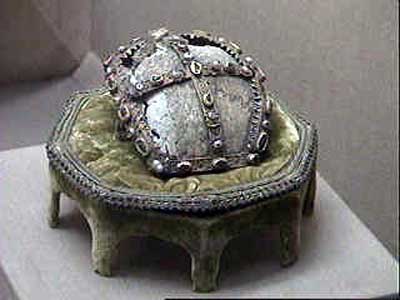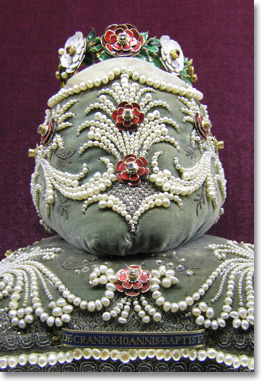
Another relic housed in Munich
In the Middle Ages, at least three different locations claimed to possess the severed head of John the Baptist. If such a claim were made today, we’d witness an immediate outcry and investigation. CNN would have a field day. Anderson Cooper would be in his element.
A lone medieval scholar, John of Salisbury, did note that two of the claims must be wrong, but most medieval people were not remotely bothered by such issues. Because of the distances involved in travelling to those three places, they didn’t have to deal with the problem of John the Baptist having three heads (or the problem of the church propagating untruths). Divine Providence explained everything. Things were as they were because God had determined it. For them the real threat was the Devil.
Agents of the Devil were to be found everywhere. In my novel, Passion in the Blood, the hero, Robert de Montbryce glances out the window of his castle in Normandy and sees a flock of crows flying overhead. Foreboding sweeps over him that something evil has happened to his heroine, Dorianne de Giroux.
Celtic speakers were often shunned as agents of the Devil. The persecution of the Welsh  Celts by the Normans is a central theme in several of my books. My latest release, Defiant Passion, is the story of Celts and their struggle against the Norman invaders. I will gift a copy to one lucky commenter today.
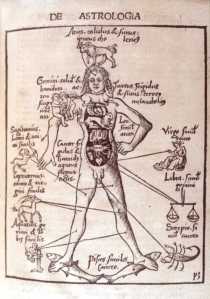
Superstition ruled people’s lives. They had no understanding of the laws of physics, nature, nor even how the human body worked. In their minds, anything could happen—there were no limitations. Sorcery really did work. An astrologist should be consulted for advice on when to take medicine or when to take in the washing. Lead could be turned into gold.
 There was widespread belief in prophecy and, difficult as it might be to believe the acceptance of some of the political prophetical works, sometimes works of science and philosophy were even more outlandish.
Here, for example, is a famous passage from Roger Bacon, a 13th century scientist and philosopher:
“Ships may be made to move without oars or rowers, so that large vessels may be driven on the sea or on a river by a single man, and more swiftly than if it were strongly manned. Chariots can be built which can move without any draught animal at incalculable speed…Flying machines might be made in which a man might sit, turning a certain mechanism whereby artfully built wings might beat the air, in the manner of a bird in flight. Another instrument could be made which, although small, will lift or lower weights of almost infinite greatness…Again, instruments might be made for walking in the sea, or in rivers, even to the very bottom…bridges might cross rivers without pier or prop.”
Hmmm!
 In health matters, medical knowledge was based largely on astrology, herbology, religion, philosophy, hearsay and desperation. A priest at St. Bartholomew’s Hospital at the end of the 14th century—John Mirfield—recommended the following procedure:
“Take the name of the patient, the name of the messenger sent to summon you, and the name of the day on which the messenger first came to you. Join all their letters together. If an even number result, the patient will not escape. If the number be odd, he will recover.”
They believed the entire universe was made up of four elements: fire, water, earth and air, which were mirrored in the four basic humors of the body: choler, phlegm, black bile and blood. Sometimes doctors did not actually see their patients, basing their diagnosis on the position of the stars, the colour and smell of the patient’s urine and the taste of his blood.
Magic was tolerated, even encouraged. One of my villains, Morwenna, has as many sickly customers from the village for her hexes and spells as the heroine, Rhonwen, a healer known for her skill with herbs, salves and potions. (Defiant Passion)
Magic was one thing. Heretical magic was another. In 1324, an Irish gentlewoman, Dame Alice Kyteler, and her companions, were accused of renouncing Christ, making sacrifices of living chickens to demons, cursing their husbands and creating unguents from the intestines of the chickens. They had, it was claimed, boiled these intestines with worms, dead men’s nails, various herbs and the garments of unbaptized dead children in the skull of a beheaded thief.
Unfortunately for the “heretics” these claims were made in Ireland. Had they been made in England, they would probably have been hung. As it was, Alice and her companions were burned alive.
As Ian Mortimer states in his book, The Time Traveler’s Guide to Medieval England, “the past is a foreign country”.
Or is it?
 There are at least two sites in the world today that still claim to be the repository of the skull of John the Baptist. Where is Anderson Cooper when you need him! Do you shudder a little when you see a mass migration of crows? Seen “The Birds” recently? Maybe I should ease off the husband cursing for a while! And flying machines? Don’t make me laugh!
Did someone say Feng Shui?
Anna has very kindly offered to give away one free copy of her book. So leave a comment to be entered in the drawing.